
Scaling sustainability with trustworthy data


Consumers, export markets, regulators, and supply chain partners are demanding greater transparency in how food is grown and produced. A simple 'sustainable' label is no longer enough...they want proof: emissions data, and impacts on biodiversity, water, soil, animals, and communities.
“On farm sustainability is the number one driver in the importance of building trust with consumers and markets, and this includes highlighting the visible identity of farmers” - Dr Kieren Moffatt, Voconiq, Australian Agricultural Sustainability Exchange 2025
“Producers must tell their sustainability stories to maintain competitive advantage. We need to develop a national story of Australian agricultural sustainability that is clear, evidence-based and trusted” - Matt Lowe, DAFF, Australian Agricultural Sustainability Exchange 2025
Delivering on these evolving market and regulatory expectations requires trustworthy data, which is where consistency in measurement, reporting, and verification (MRV) standards comes in.
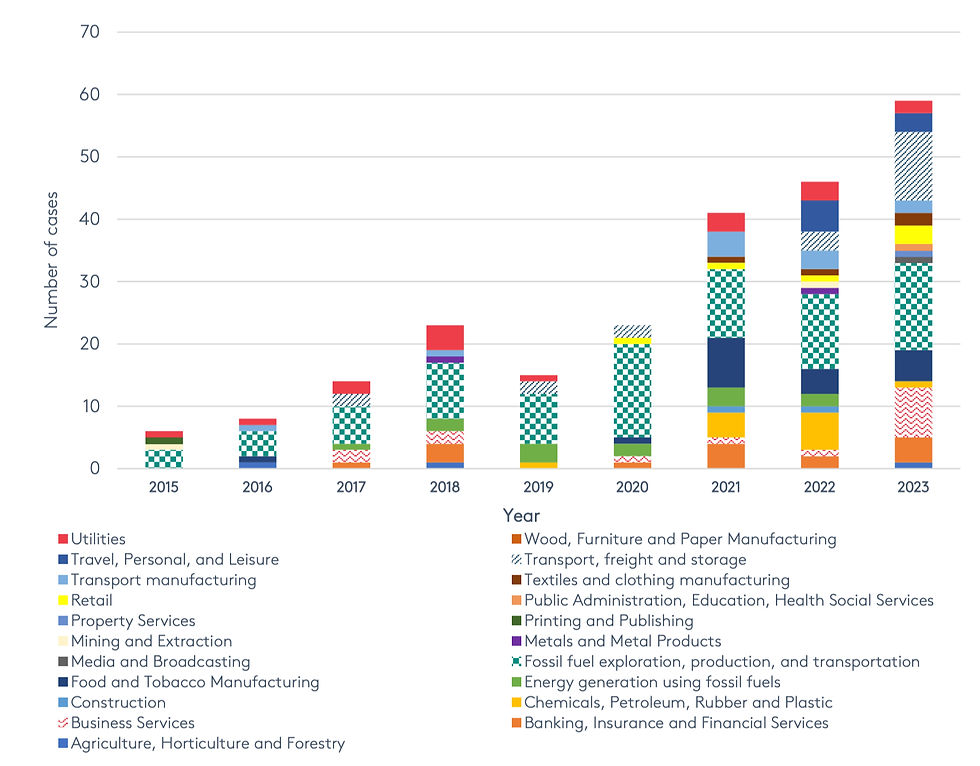
At SEAOAK, we believe that collecting, tracking, and reporting sustainability data in a consistent, robust way across agricultural sectors is foundational to a more sustainable and resilient industry. Without robust, transparent data capture and verification, bold sustainability claims risk becoming empty promises, which not only undermines confidence but also invites financial and reputational penalties. Global cases of companies being targeted for greenwashing are increasing year on year (see figure 1).
“Firms experience, on average, a 0.41% fall in stock returns following a climate-related filing or an unfavourable court decision.”

We recently met with the team at Agricultural Innovation Australia (AIA), who are developing a pre-competitive solution to give Australian producers and supply chains an accessible, standardised approach to carbon accounting across multiple commodities. AIA was recently awarded a $6.4 million grant from the Department of Agriculture, Fisheries and Forestry, highlighting the critical need for consistent, accurate, and accessible environmental accounting tools for Australia’s rural industries, and emphasising the value of collaborative, standardised approaches to support mixed enterprises.
“There is a lack of consistency in reporting across the agriculture industry, creating unnecessary burden for producers” - Anna Hooper, Australian Grape & Wine, Australian Agricultural Sustainability Exchange 2025
The lesson is clear: credible, consistent data builds trust across the supply chain, reduces the risk of greenwashing, and supports access to capital.
“Producers are already doing great things, but they don’t know how to communicate it” - Angela Schuster, Schuster Consulting Group, Australian Agricultural Sustainability Exchange 2025
Balancing rigour and flexibility

Scaling sustainability responsibly means balancing strong frameworks with flexibility. As Dave Lamb from Food Agility CRC reminded us at AgXchange, “we can’t let perfection be the enemy of good.”
On the one hand, we need frameworks that are strong enough to ensure credibility, prevent greenwashing, and attract long-term support (e.g. the Australian Beef Sustainability Framework and the Australian Cotton Sustainability Reporting Framework).
On the other hand, those frameworks must be adaptable enough to allow for uptake by a large majority of producers, even while methods and metrics are still improving.
When we get that balance right, the result is a system that builds confidence across the supply chain, rewards those who are doing the right thing, and supports new practices and technologies on their pathway to maturity.
Turning data into value
The burden of reporting is one of the biggest challenges facing producers, but one thing is clear - the growing data burden isn’t translating into impact or value.
Current approaches are poorly designed to measure or actually reduce environmental impacts, including Scope 3 emissions, and do little to address the existential risks producers face, including from climate-related risks. Too often, the data collected (predominantly in the form of paperwork or producer surveys) serves only as a ‘license to operate’ for brands, or annual industry body reporting, and even then, it frequently falls short.
Financial institutions are increasingly incorporating ESG factors into risk assessments, which means producers who can demonstrate progress with verifiable data will be better positioned.
“There is a clear link between environmental sustainability and financial sustainability. CBA is already supporting producers who demonstrate commitments to sustainable land management practices”. - Carmel Onions, CBA, Australian Agricultural Sustainability Exchange 2025
Right now, data collection often amounts to paperwork that satisfies compliance or social licence to operate but fails to drive real impact.
Example in practice

SEAOAK’s beef supply chain traceability & sustainability pilot is a great example of putting those ideas and industry challenges into practice beyond just emissions measurement. Here’s how the pilot is tackling broader sustainability data challenges:
Standardisation of reporting framework: The pilot creates a common data framework aligned with recognised sustainability standards (ABSF, GRI, ASRS), reducing duplication and eliminating the need for farmers to create their own reporting frameworks
Integrating existing tools: Using NLIS, eNVD, AgTrace, and emissions calculators so data is consistent and comparable. Our goal is not just to build another measurement and reporting platform, but to create a true data-sharing network, one where farmers retain ownership of their data and can choose to share it securely. Over time, we also aim to recognise and reward farmers who demonstrate, through their data, that they are strengthening landscape resilience and caring for nature
Reducing producer burden: Streamlines data capture at the farm level into one system that can serve multiple brand and regulatory needs, cutting down repeated requests
Enhancing flexibility: Provides structured reporting that can be tailored to different timelines (monthly, quarterly, annual), without adding extra work for producers
Scalable digital platform: Integrates economic, animal, social, governance, compliance, and environmental impact data in one digital system, improving accuracy and usability across the value chain
Operational value via predictive analytics & AI: Moves data collection beyond compliance, using insights to improve on-farm performance, reduce costs, and support animal welfare, environmental, social and economic outcomes
Ensuring end-to-end traceability: Leveraging blockchain and GS1 standards for paddock-to-plate visibility. This ensures every stage supports proof of Australia’s world-class standards in quality, sustainability, and integrity
Read more: Beef Sustainability Traceability | SEAOAK
During AgXchange 2025, Carmel Onions from the CBA also highlighted the importance of “supply chain sharing and valuing data” - and our pilot reflects that, ensuring farmers retain ownership while enabling secure, sovereign data exchange.
The future of sustainability depends on consistent measurement and verification
SEAOAK is committed to building systems that are credible enough to inspire trust, but flexible enough to foster innovation. Because the future of sustainability depends on proving, not just promising, that agriculture can deliver positive outcomes for people, animals, and the planet.
We’re excited by Agricultural Innovation Australia’s pre-competitive carbon accounting solution, supported by a $6.4 million DAFF grant. It’s a strong step toward standardised, accessible tools that benefit mixed enterprises across industries.
The future of sustainability depends on proving we can measure and verify it consistently.
For SEAOAK, that means building systems that are credible enough to inspire trust, yet flexible enough to foster innovation. It means treating data capture not as a box-ticking exercise, but as the foundation for resilience, market access, access to capital, and long-term sustainability.
Interested in working or partnering with SEAOAK? We’d love to hear from you
Carli Davis - CSO, Co-Founder


Comments